

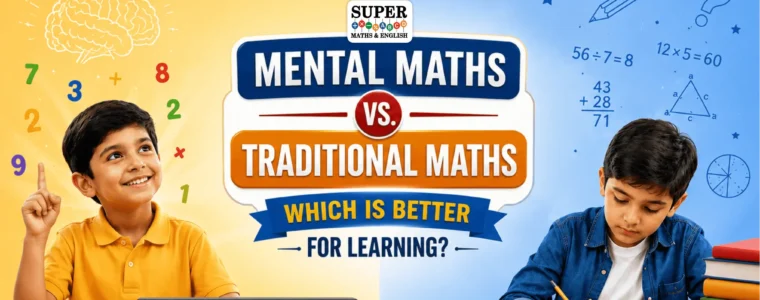
Mental Maths vs Traditional Maths is not really about choosing one method over the other. Both approaches play an important role in developing mathematical skills, but they focus on different ways of learning and solving problems. While one encourages children to calculate and reason in their heads, the other provides structured methods that help them understand mathematical concepts step by step.
For children to develop strong mathematical foundations, understanding how these two approaches work can help parents and educators create a balanced learning experience.
Mental Maths vs Traditional Maths
What Is Mental Maths?
Mental maths involves solving calculations in your head without immediately depending on a calculator, paper, or written formulas. Children may use number patterns, memory, estimation, shortcuts, and logical reasoning to arrive at an answer.

For example, instead of writing down 48 + 27, a child might mentally add 48 + 20 and then add 7 to reach 75.
The focus is not only on speed. It encourages children to understand numbers, recognise relationships, and find efficient ways to solve problems.
What Is Traditional Maths?
Traditional mathematics generally involves structured, written methods for solving mathematical problems. Children are taught specific formulas, procedures, calculation techniques, and step-by-step approaches.
For example, when solving a multiplication problem, students may write the numbers vertically and follow a particular multiplication method to arrive at the answer.
This approach is valuable because it gives children a clear framework for solving increasingly complex problems.
Mental Maths vs Traditional Maths: Understanding the Difference
The main difference is how children approach a mathematical problem.
Mental calculation encourages children to think internally, recognise patterns, and use flexible strategies. Traditional methods often provide a structured process that children can follow on paper.
Neither approach is automatically better. They develop different skills and can complement each other when used appropriately.
A child who understands written methods but also develops strong mental calculation abilities can have greater flexibility when approaching mathematical problems.
1. Mental Calculation Encourages Faster Thinking
One advantage of mental calculation is that it can help children become quicker at handling familiar calculations.
Instead of writing down every step, children can use strategies they have learned to arrive at an answer more efficiently.
For example, recognising that 50 × 2 is 100 allows a child to solve the calculation almost instantly.
With regular practice, children can develop greater confidence when dealing with numbers in their heads.
2. Traditional Methods Build Strong Mathematical Foundations
Written mathematics remains extremely important, particularly when children begin working with more complicated concepts.
Long multiplication, division, fractions, algebra, geometry, and equations often require organised written steps. Traditional methods help children understand the processes involved and provide a way to show how they reached an answer.
Written working can also make mistakes easier to identify and correct.
3. Mental Calculation Develops Flexible Problem-Solving
A major strength of mental maths calculation is that children can learn to approach the same problem in different ways.
For example, when calculating 98 + 35, a child might think of it as 100 + 35 – 2. This strategy simplifies the calculation without requiring a traditional written method.
This type of flexible thinking encourages children to look for patterns and relationships rather than automatically following one procedure.
4. Traditional Learning Supports Complex Problems
As mathematical concepts become more advanced, writing down calculations becomes increasingly useful.
Imagine solving a multi-step algebraic equation. Keeping track of every number and operation mentally could be difficult. Writing each step provides structure and reduces the likelihood of forgetting information.
Traditional methods therefore remain essential for developing advanced mathematical skills.
5. Mental Calculation Can Build Confidence
Successfully solving a calculation without assistance can give children a sense of achievement.
When children realise that they can work with numbers independently, they may become more willing to attempt challenging questions.
This confidence can be particularly valuable for children who initially feel uncomfortable or anxious when dealing with mathematics.
6. Traditional Methods Encourage Accuracy and Organisation
Written calculations allow children to see each stage of their work. This can help them understand where an error occurred and how to correct it.
It also teaches children to organise information clearly, follow mathematical procedures, and present their solutions in a way that others can understand.
These skills become increasingly important as mathematical problems become more complex.
Which Approach Is Better for Children?
Rather than asking which method is better, it can be more useful to ask which method is appropriate for a particular problem.
For quick calculations, estimation, number relationships, and everyday numerical situations, mental strategies can be highly useful.
For complex calculations, equations, detailed problem-solving, and advanced mathematics, written methods provide valuable structure.
A balanced learning approach can therefore combine both techniques. Children can use mental strategies where they are efficient while relying on written methods when a problem requires more detailed working.
How Can Parents Support Both Approaches?
Parents can encourage children to use numbers in different ways throughout everyday life.
Ask them to calculate simple totals while shopping, estimate the cost of items, work out how much change they should receive, or calculate how much time remains before an activity.
For more complicated problems, encourage children to write down their working rather than trying to keep every step in their head.
The objective should be to help children understand which strategy to use and when.
Why a Balanced Approach Works Best
Mathematics is not a single skill. It involves calculation, reasoning, memory, logic, problem-solving, accuracy, and communication.
Mental calculation can strengthen speed, flexibility, and confidence, while traditional mathematics can provide structure, accuracy, and a foundation for advanced concepts.
Combining both approaches allows children to develop a wider range of mathematical abilities. Instead of treating the two methods as competing systems, parents and educators can use them together to create a more complete learning experience.
Conclusion
Mental Maths vs Traditional Maths should not be viewed as a competition where one method needs to replace the other. Each approach offers different benefits and supports different stages of mathematical learning.
Mental maths can encourage flexible thinking, faster numerical reasoning, and confidence, while traditional written methods provide structure, accuracy, and the tools needed to solve complex mathematical problems.
The most effective approach is often a combination of both. Giving children opportunities to calculate mentally while also teaching them structured written methods can help them become adaptable, confident, and capable mathematical thinkers.
Related Articles
The Rise of Abacus Maths Education: How Kids Are Mastering Maths in a Fun Way
Beginner’s Guide to Speed Maths Using Abacus Techniques
Step-by-Step Beginner’s Guide to Learning Abacus Maths for Kids
How Abacus Training Boosts Mental Maths and Brain Development
Inside the Brain of an Abacus Champion: What Makes Them So Fast?
Mental Maths vs Traditional Maths in London | Mental Maths vs Traditional Maths in Birmingham | Mental Maths vs Traditional Maths in Manchester | Mental Maths vs Traditional Maths in Liverpool | Mental Maths vs Traditional Maths in Leeds | Mental Maths Classes in London | Mental Maths Classes in Birmingham | Mental Maths Classes in Manchester | Mental Maths Classes in Leeds