
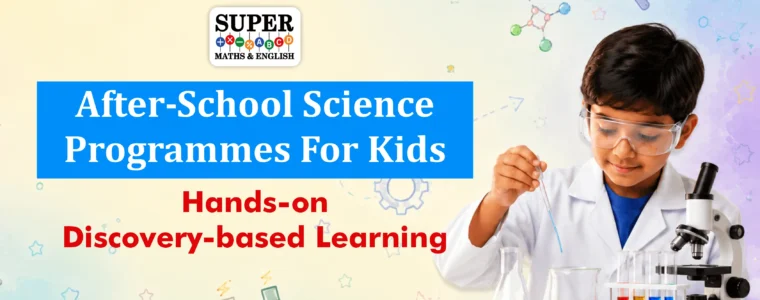
After-school science programmes are the answer to your quest to give your child the much-needed support. When parents start searching for ways to keep their children engaged after the final school bell rings, they usually look for something that balances productivity with pure, screen-free enjoyment. While traditional sports or music lessons are great, a growing number of families are turning to a more dynamic alternative: interactive STEM education. After-school science programmes offer the perfect environment for kids to trade textbook memorisation for genuine, hands-on discovery.
After-School Science for Kids
By changing the focus from strict grading to active experimentation, such programs offer more than mere fact-learning. They assist students in developing the ability to think, solve problems, and understand the world with genuine confidence.
So, Why Hands-On Science for Kids?
The traditional classroom setting is essential for foundational learning, but tight schedules often limit deep, experimental exploration. Science for kids shouldn’t just be about reading a chapter on chemical reactions or memorizing the water cycle. Children thrive on mixing the solutions, building the circuits, and seeing the results right before their eyes.

Discovering through hands-on learning is an excellent way to bridge this gap, as it enables students to turn abstract scientific concepts into real-life experiences they can touch and feel. Children who use the scientific method for their activities, making hypotheses, conducting experiments, not getting the expected results, and continuing their efforts, hold their learning for a longer time and strengthen the critical thinking skills that will help them in all their studies.
What Do Kids Actually Gain From These Programmes?
Regularly taking part in controlled, scientific methodology-based afternoon classes contributes to one’s growth in different aspects.
Boosting Confidence Through Trial and Error
In a typical classroom, a wrong answer can feel discouraging. In after-school science programmes, failure is treated simply as data. If a bridge, constructed from popsicle sticks, happens to fall down under the weight, children won’t get a low score. On the contrary, they figure out which parts of the structure were weak and come up with a new design. Iteratively, it equips children with great resilience and intellectual confidence, showing them that setbacks are merely stepping stones in finding a working solution.
Enhancing Collaborative Problem-Solving
Scientific breakthroughs in reality scarcely happen in isolation, and the same is applicable to very young childhood development. When kids make a model volcano or program a robot in small teams, they talk through their ideas, listen to each other, and divide the work. These team activities are just like actual STEM workplaces; they prepare students for acquiring critical social skills such as negotiating, speaking effectively, and working together.
Inspiring Lifelong Curiosity
When science for kids is framed as an adventure rather than a chore, it sparks an intrinsic desire to learn. Those mesmerising moments when a chain of molecules transforms into goo or the seed plants itself in a homemade hydroponic set up can elicit the real feeling of amazement. This early exposure breaks down the intimidation factor that’s often linked with advanced STEM subjects, and it makes the child comfortable in learning new things in the fields of technology, engineering, and environmental sciences throughout his/her entire life.
How to Choose the Right Programme for Your Child?
For best outcomes, select programs that focus on small student-to-teacher ratios and allocate most of the time of their sessions to physical building or testing rather than lecturing.
Exceptional after-school science programmes focus heavily on open-ended challenges where there isn’t just one “correct” way to finish a project. When you put your child into a thorough, discovery-based program, you are not simply occupying your child’s time in the afternoon; you are equipping him or her with the skills to take an active part in questioning, analysing, and confidently influencing the world.
Related Articles
How to Find the Best Science Coaching Classes for Kids That Actually Help Learning
Shape Your Child’s Future with Skills in Computing Science for Kids
After-school science programmes in London | After-school science classes for kids in Manchester | STEM after-school programmes in Birmingham | Hands-on science workshops for children in Leeds | After-school STEM activities in Bristol | Science enrichment programmes for kids in Sheffield | Interactive science classes for children in Nottingham | STEM learning programmes for kids in Cambridge