
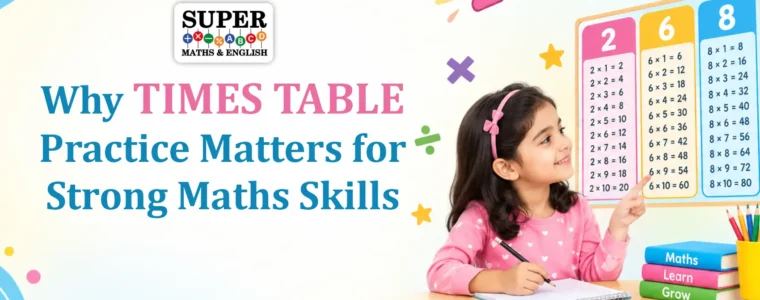
It is one of the simplest and most effective ways to build a strong foundation in mathematics. Knowing multiplication facts quickly helps children solve calculations without spending too much time working out basic facts. Strong multiplication skills allow children to approach more advanced mathematical concepts with greater confidence. From division and fractions to percentages and algebra, many areas of maths rely on a good understanding of multiplication. Regular practice helps children develop accuracy, speed and confidence in their everyday maths work.
Times table practice Improves Calculation Speed
It helps children recall multiplication facts quickly rather than calculating each answer from scratch. This automatic recall is particularly useful when children are working under time limits in school tests, mental maths activities and competitive examinations. Developing multiplication abilities means that children can spend more time thinking about how to solve a problem instead of struggling with basic calculations. With consistent practice, facts such as 6 × 7 = 42 or 8 × 9 = 72 become easier to remember, making calculations faster and more efficient.
It Supports Division Skills
Times tables are closely connected to division because multiplication and division are inverse operations. When children know their times tables well, they can use this knowledge to solve division questions more confidently. For example, knowing that 7 × 8 = 56 makes it easier to understand that 56 ÷ 7 = 8. Developing multiplication skills therefore supports children’s understanding of division and helps them recognise relationships between numbers. This connection becomes increasingly important as children progress to fractions, ratios and more complex mathematical problems.

It helps with Fractions, Decimals and Percentages
Proper practice provides useful number knowledge that children can apply to many different mathematical topics. Calculation skills are particularly valuable when working with fractions, decimals, percentages, measurements and ratios. For example, understanding multiplication makes it easier to find equivalent fractions, calculate percentages of quantities and convert between different units. When basic multiplication facts are already secure, children can focus their attention on understanding the mathematical method rather than struggling with individual calculations.
IT Builds Confidence in Maths
It can also have a positive effect on a child’s confidence. Children who find multiplication difficult may hesitate when answering questions or become anxious about making mistakes. Regular, manageable practice can help them become more comfortable with numbers and gradually improve their multiplication skills. Using games, quizzes, flashcards, mental maths challenges and timed activities can make practice more engaging. Celebrating improvement rather than focusing only on perfect scores can also encourage children to keep practising.
Prepares Children for Competitive Exams
It is particularly useful for children preparing for school assessments and competitive examinations such as the 11+ and maths competitions. These exams often require children to work accurately within limited time. Strong multiplication skills can help children complete numerical calculations more efficiently and leave more time for challenging questions. Regular revision of times tables also reduces the mental effort needed for simple calculations, allowing children to concentrate on problem-solving, reasoning and applying mathematical concepts.
Practice Should Be Regular and Enjoyable
The practice works best when it becomes a regular part of a child’s learning routine rather than an occasional activity. Short, consistent sessions can be more effective than long periods of repetitive practice. Parents and teachers can introduce counting skills through puzzles, mental maths games, real-life calculations and interactive activities. Gradually increasing the difficulty can keep children challenged without making practice overwhelming. The goal should be to develop accurate recall while helping children understand how multiplication works.
Times table practice with Supermaths
Times table practice becomes more engaging when children learn through structured activities and interactive methods. Supermaths helps children strengthen their overall calculation skills through its game-based and engaging maths learning approach. Through activities designed to improve mental calculation, speed and accuracy, children can practise essential mathematical facts while developing greater confidence with numbers. Supermaths’ approach can help make regular maths practice more enjoyable and encourage children to build strong foundational skills that support their progress in school maths, mental maths and competitive examinations. With consistent guidance and practice, children can develop multiplication skills that become valuable throughout their mathematical journey.
Conclusion
Times table practice is much more than memorising multiplication facts. It helps children develop faster calculation, stronger multiplication skills, better number sense and greater confidence. Because multiplication is used across many areas of mathematics, building fluency at an early stage can make future learning easier. With regular practice, engaging activities and the right guidance, children can turn multiplication from a challenging topic into an important strength in their maths learning.
Related Articles
Maths Competition for Kids: Why Olympiad Practice Builds Strong Maths Skills
The Rise of Abacus Maths Education: How Kids Are Mastering Maths in a Fun Way
Beginner’s Guide to Speed Maths Using Abacus Techniques
Step-by-Step Beginner’s Guide to Learning Abacus Maths for Kids
How Abacus Training Boosts Mental Maths and Brain Development
Times Table Practice in London | Times Table Practice in Birmingham | Times Table Practice in Manchester | Times Table Practice in Leeds | Mental Maths Classes in London | Mental Maths Classes in Birmingham | Mental Maths Classes in Manchester | Mental Maths Classes in Leeds | Mental Maths Classes in Glasgow | Mental Maths Classes in Liverpool | Mental Maths Classes in Bristol | Game Based Maths Learning Classes in Sheffield | Game Based Maths Classes in Nottingham | Mental Maths Classes in Leicester