
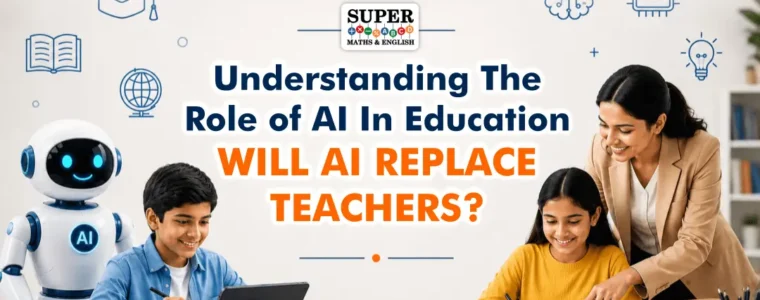
Understanding the Role of AI in Education is extremely significant. If you’re a parent scrolling through headlines about chatbots writing essays and apps solving math problems in seconds, you’ve probably asked yourself, ” Is a robot going to replace my child’s teacher? It’s a fair question. AI no longer a futuristic idea — it’s already sitting in classrooms, homework apps, and tutoring platforms across the world. But before you start worrying about teachers becoming obsolete, let’s slow down and look at what’s actually happening.
The Rise of AI in Education
Over the past few years, AI has grown from a buzzword into a genuine classroom companion. Schools are using it to personalise lessons, grade assignments faster, and identify which students need extra help before they fall behind. For students, this means less one-size-fits-all learning and more support tailored to how they actually learn.
But here’s the thing: AI isn’t a replacement for the people running the classroom. It’s a tool that helps teachers do their jobs better — not a substitute for their judgment or empathy.

What AI Can Actually Do for Kids
When parents ask about AI for children’s learning, the real value becomes clear once you look past the hype. Here’s what AI genuinely brings to the table:
- Personalised pacing — AI tools can adjust difficulty in real time, so a child who’s struggling with fractions gets more practice, while a child who’s mastered them moves ahead.
- Instant feedback — instead of waiting days for a graded quiz, students get immediate answers on where they went wrong.
- Accessible support — kids who need extra explanation, translation, or repetition can get it any time, without feeling singled out in front of classmates.
- Engaging formats — gamified quizzes, interactive stories, and adaptive worksheets make learning feel less like a chore.
Used well, AI for children’s learning can turn homework time from a nightly battle into a more independent, confidence-building experience.
What AI Can’t Replace
Here’s where the “will AI replace teachers” question really gets answered: no algorithm can replicate what a good teacher does outside the textbook. Teachers notice when a child is quiet because they’re distracted, not because they don’t understand. They mediate friendships, teach patience, and model how to handle frustration. AI in education can flag a wrong answer, but it can’t sit beside a nervous kid before a spelling bee and tell them they’ve got this.
AI also has real limits when it comes to nuance. It doesn’t know your child’s history, their bad week at home, or the fact that they need a little encouragement instead of another worksheet. Human teachers bring context, emotional intelligence, and mentorship — things AI tools are not built to provide, no matter how advanced they get.
The Real Role of AI in Education: A Partner, Not a Replacement
Rather than framing this as AI versus teachers, it’s more accurate and more useful to think of AI as a partner to teachers. Think of it like a calculator in a math class: it doesn’t replace the need to understand math, but it removes friction so students and teachers can focus on deeper learning.
This partnership model is already reshaping classrooms:
1. Teachers use AI platforms to identify learning gaps across an entire class in minutes, not weeks.
2. Students use AI for children’s learning apps at home to reinforce what they learned in class, at their own pace.
3. Parents use AI-powered progress reports to understand exactly where their child needs support, without guessing.
In every one of these cases, the technology supports the relationship between teacher and student , it doesn’t erase it.
What This Means for Parents and Students
If you’re a parent, the smartest move isn’t to fear AI or to blindly trust it either — it’s to understand it. Ask your child’s school how they use AI tools, and look for platforms that supplement classroom teaching rather than replace structured lessons entirely.
If you’re a student, think of AI for children’s learning tools the way you’d think of a study buddy who never gets tired: useful for practice, feedback, and exploring new topics, but not a substitute for asking your teacher a real question or working through a hard problem with a friend.
The honest answer to “will AI replace teachers?” is no — not because the technology isn’t powerful, but because teaching was never just about delivering information. It’s about connection, and that’s something AI in education was never designed to replace.
If you’re a parent or student curious about how AI actually works and how to use it responsibly for learning, BYITC offers AI courses designed to build real, practical skills not just theory. Whether you want to understand AI as a parent guiding your child’s education, or you’re a student who wants to get ahead of the curve, our courses break things down in a simple, hands-on way. Come learn how to make AI work for you, not the other way around.
Related Articles
AI for Kids: Learning Coding and Machine Learning the Fun Way
How Minecraft Coding Classes Are Shaping the Next Generation of AI Developers
AI in Education London | AI in Education Manchester | AI in Education Birmingham | AI in Education Leeds | AI Course for Kids in Nottingham | AI Classes for Kids in Sheffield | Artificial Intelligence Classes for Kids in Edinburgh |Artificial Intelligence Classes for Kids in Liverpool